Subs: charge for games played, not invitations
Published · Updated
Roberto Santana runs the SMBHL ball hockey league in Laval, Quebec.
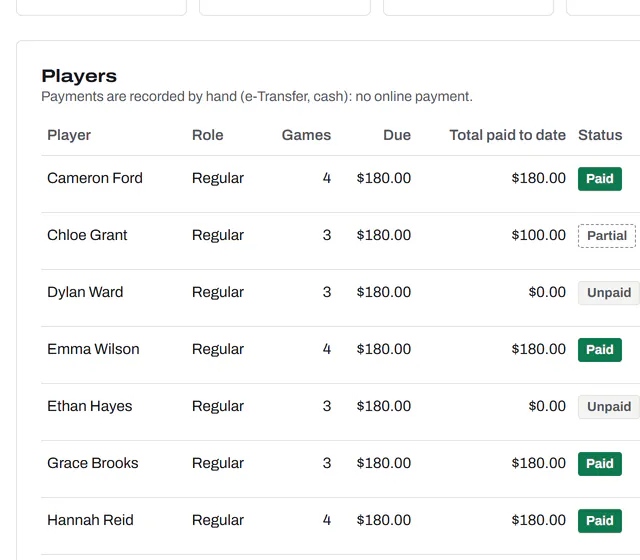
To charge your league's subs, the simplest and fairest way is a flat amount per game played, decided before the season and written into your rules. Set it so a sub pays about what a regular pays for one game, collect it the same day or once a month, and write down every game. A spreadsheet is enough to track it; a league tool like Notre Ligue can also work out what each sub owes from the games played.
You invited Sam to fill in for a goalie. He said yes, then something came up and he couldn't make it. Do you still bill him? If you hesitate, your rule isn't written yet.
Key takeaways
- Charge for games played, not accepted invitations.
- A sub should pay about what a regular pays for one game.
- Decide before the season what a sub pays for a game in net, even if it's nothing.
- Write down who played after each game, in the same place as payments.
What are the options for charging subs?
Four approaches come up often, not all equally easy to defend.
| Option | How it works | Pros | Cons |
|---|---|---|---|
| Per game played | A flat amount for each game the sub played | Fair, simple to explain | You have to note who played |
| Per accepted invitation | They pay as soon as they say yes, even if they don't show | Discourages casual yeses | Unfair when the game is cancelled, and a source of arguments |
| Season pass for subs | One amount for the season, however many games | One payment to track | Too much for someone who comes twice, too little for someone who comes every week |
| Free subs | They pay nothing | Easy to find people | The regulars pay for them |
How much should you charge per game?
Start from the regulars' price. Divide the season price by the number of games: that's what a regular pays for one game. A sub's price should sit around that amount.
For example: a $150 season for 15 games works out to $10 a game for a regular. A sub at $10 a game pays the same for the same game. Some leagues ask a bit less to attract subs, others a bit more because a sub doesn't commit to the season. In my league, a sub pays $5 per game played, and nothing for a game in goal.
What's fair to the regulars?
A regular pays for their spot for the whole season, even the weeks they miss a game. A sub pays only when they play. Both are fair as long as the price of one game is similar on both sides.
What doesn't work is a sub who plays every week for much less than a regular. If they come to almost every game, offer them a regular spot next season. And don't count on sub money to pay for the gym: some weeks, none show up.
Why not accepted invitations?
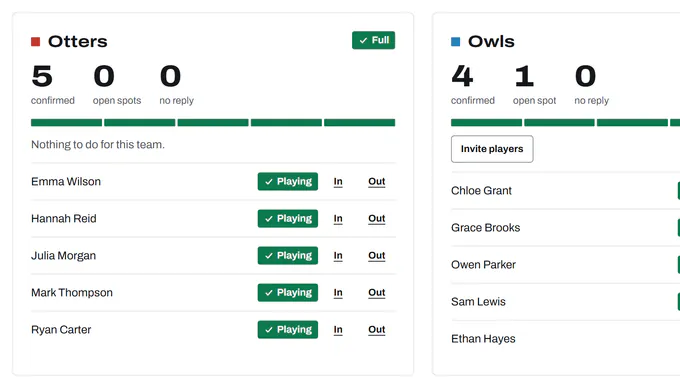
Because what matters is who was on the floor. A sub who says yes and then isn't placed, or whose game is cancelled, cost the league nothing. Three traps come up often:
- Billing by the season. A sub who comes twice shouldn't pay a regular's rate.
- Counting who said yes. A yes isn't a game played.
- Forgetting to write it down. Three weeks later nobody remembers who played.
What about goalie subs?
A goalie sub is often the hardest to find, and many leagues ask them for less, or nothing. It's your call, but decide before the season and put it in the same rule as the players'.
How do you collect from subs?
Two rhythms work well: the same day, at the gym or by transfer on the way home, or once a month, with one message listing the games played and the total. An Interac e-Transfer to the league's email address leaves a record; cash works too, as long as you write it down the same day. For the full method, read how to collect league fees without chasing players.
Before the season: your rule for subs
- The amount per game played for a sub.
- The amount for a game in net, even if it's zero.
- What counts as a game played: a cancelled game doesn't count.
- When and how to pay: the same day or once a month, by Interac e-Transfer or cash written down.
- Where you note who played, after each game.
- The rule sent to each sub before their first game.
Doing it by hand
A spreadsheet with one row per sub and one column per game date is enough. Put an X when they played, one column adds up the X's and multiplies by the price, another records what they paid and when. If you fill it in on game day, it takes two minutes.
With Notre Ligue
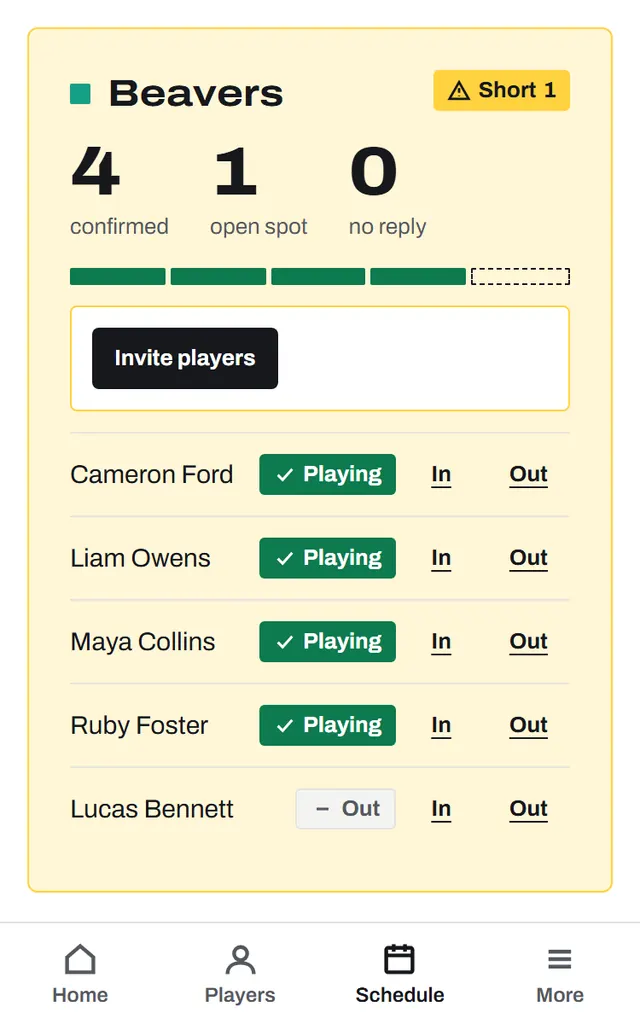
Notre Ligue doesn't collect money, but it works out what each sub owes. On the Finances page, you set per-game fees for subs: one amount for a game as a player, another for a game in net; left empty, there's nothing to pay. A game counts when the sub confirmed their spot for that game or their stats were entered, once the game has started. If they don't show, you mark them "Didn't show" and they owe nothing. A cancelled or forfeited game costs nothing. When a sub is placed on a team, their email tells them, with the game's fee and the league's email or cell number for the Interac e-Transfer. If they chose notifications instead of emails, a notification tells them instead, without the fee. You record payments, and you send a payment reminder when you decide to.
Notre Ligue sends sub invitations for you, with no account to create. Create my league
Frequently asked questions
Should a sub who said yes and didn't show still pay?
With a per-game-played rule, no. If dropouts become a problem, talk to the person rather than sending a bill.
Should subs pay more?
Not necessarily. A price close to what a regular pays for one game is the easiest to defend. Charge more and you may find fewer subs.
When should you ask for payment?
The same day, or once a month with the list of games played. What matters is that the rhythm is announced in advance.
Should goalie subs pay?
It's your call. Many leagues ask them for less, or nothing, because they're hard to find. Decide before the season and write it down.