Budget and registration price for your rec league
Published · Updated
Roberto Santana, organizer of the SMBHL, a ball hockey league in Laval.
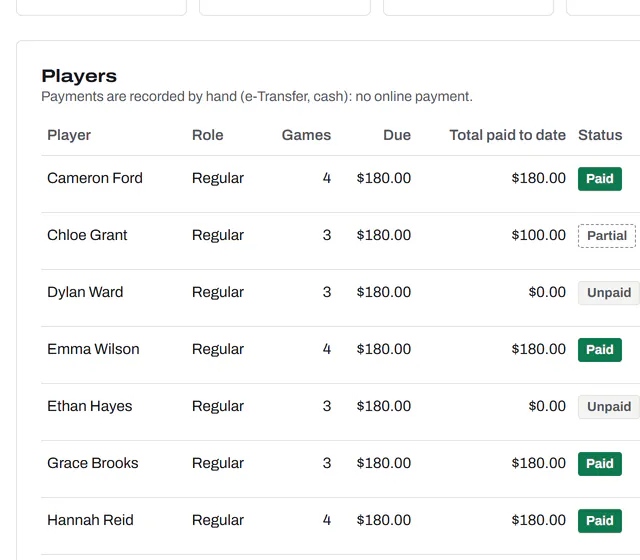
To set your league's registration price, add up every real cost of the season (rental, equipment, insurance if you have it, software, and a buffer for late payments), divide by the number of players who actually pay, then round up. After that, decide what subs pay. Whether you track it in a spreadsheet or in a tool like Notre Ligue, the method is the same.
Key takeaways
- Start from your season's real costs, not another league's price.
- Divide by the players who actually pay, not every name on the list.
- Add a buffer for late payments and dropouts, then round up.
- Decide ahead of time what subs and goalies pay.
Why not just copy another league's price?
Because their costs aren't yours. Gym or rink rental changes from one city to the next and from one time slot to another. The number of weeks, the number of players and what's provided change too. Price too low and you cover the gap. Price too high and players go play somewhere else.
Which costs should you add up for a season?
List everything the league pays for, from the first game to the last:
- Rental for the gym, rink or field. It's usually the biggest number.
- Equipment: balls or pucks, nets, pinnies, a first aid kit.
- Insurance, if you have it. Some leagues carry their own, some go through a federation, some have none. Check what applies to yours.
- Referees, if your league uses them.
- Software: nothing with a spreadsheet, or a tool's price for the months you pay.
- Extras: trophies, an end-of-season night.
- A buffer for late fees, players who leave mid-season and no-shows if you charge per game. More on that below.
How do you estimate each line?
| Cost line | How to estimate it |
|---|---|
| Rental | The price of one week times the number of weeks, playoffs included, from the written contract |
| Equipment | What you replaced last season, or a list of what wears out |
| Insurance | The policy amount, or nothing if there isn't one |
| Referees | The rate per game times the number of games |
| Software | The monthly price times the months you pay, tax included |
| Extras | A short list: trophies, end of season |
| Buffer | An amount you pick to cover a few late payments and one dropout |
How many players actually pay?
Divide by the players who pay the season price, not everyone on the list. Take out the goalies if your league lets them play free, and don't count subs: they pay per game, and you can't know ahead of time how many will come. If a regular is known for paying late, leave them in: that's what the buffer is for.
How much should you plan for late payers?
Don't pay the gym counting on every fee. In the example below, the $300 buffer and the $140 from rounding up cover almost four late fees. A player still owes $40 at the end of the season? Note the balance and carry it to next season. A player overpaid? That's a credit for next time. The deadline, the deposit and the reminder are in how to collect league fees without chasing players.
A full worked example
For example, with round, made-up numbers: a league of 40 regular players, including 4 goalies who play free, plays 20 weeks in a gym.
- Rental: 20 weeks at $150, so $3,000.
- Equipment: $200.
- Insurance: $300.
- Software: $60.
- Extras: $140.
- Buffer: $300.
The total is $4,000. There are 36 paying players. $4,000 divided by 36 is $111.11. Rounded up to the next $5, the price is $115. With 36 players at $115, the league takes in $4,140: the extra $140 goes into the buffer.
In this example, subs pay $10 per game played. That money isn't in the calculation: if a lot of subs come, it grows the buffer or lowers next season's price.
What should subs pay?
Charge subs for games played, not for invitations accepted. A fixed amount per game is the easiest to explain and to track. Also decide whether a sub in goal pays the same price, a different one, or nothing. The full rule is in what to charge subs.
Before you announce the price
- The rental contract is confirmed: number of weeks and price.
- Every line is in the total, software and extras included.
- The number of paying players is realistic, without free goalies or subs.
- The price is rounded up.
- The sub price per game is decided, goalies included.
- The payment deadline and how to pay are written down.
- What happens when a player leaves mid-season is written down.
Doing it by hand
A spreadsheet handles this just fine. One tab for costs: the line, the estimate, then the real amount once you pay it. A second tab for players: what each one owes, what they've paid and when. One cell does the division, another rounds up. At the end of the season, compare the estimate with the real numbers: that's your starting point for next season's price.
With Notre Ligue
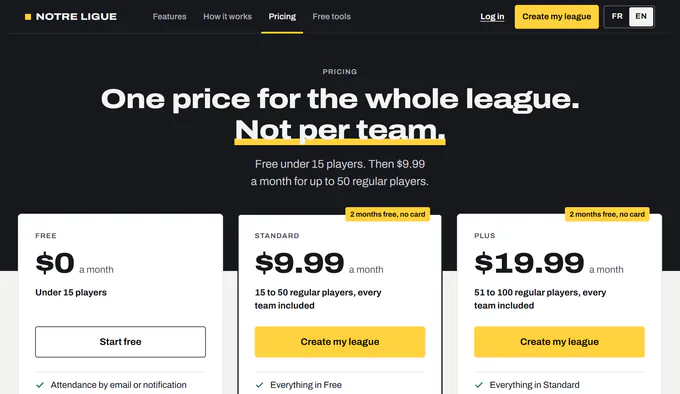
Notre Ligue doesn't set your price for you, but it keeps the numbers in the same place as attendance. On the Finances page, you enter the players' season fees (or a per-game price), the subs' per-game price, goalie fees if there are any, and the season's expenses: rental, equipment, technology and other. You see who has paid and what's left to receive, and you can email payment reminders with your Interac e-Transfer details. Players pay you directly: Notre Ligue never handles the money. For the "software" line of your budget, it's free under 15 regular players, $9.99 CAD a month up to 50 and $19.99 CAD up to 100, before tax, with 2 free months and no card: see the plans.
Frequently asked questions
Should goalies pay?
It's your call, but decide before the season and write it down. Some leagues charge goalies less, or nothing, because they're hard to find. If they don't pay, take them out of the number of paying players.
What if costs change mid-season?
Keep the announced price and use the buffer. Changing the price mid-season causes more problems than it solves. Note the gap and adjust next season's price.
Should I round the price?
Yes, always up, to an amount that's easy to pay, like the next $5. The difference goes into the buffer.
What do I do with money left over at the end of the season?
Say so ahead of time: it can stay in the kitty for next season, pay for the end-of-season night, or lower the next price. What matters is that players know where it goes.