Last-minute no-shows: what to do the night before a game
Published · Updated
Roberto Santana, organizer of the SMBHL, a ball hockey league in Laval.

When players cancel the night before a rec league game, apply the rule you settled before the season: call your subs in order, and if nobody is free, the team plays short, borrows a player or forfeits. The real work happens before the season: a reply deadline, a short-handed rule and a rule for repeat no-shows. A league tool like Notre Ligue can call subs for you; a spreadsheet and texts do the job too.
Saturday, 9 p.m. A message: "Turns out I can't make it tomorrow." Then a second one. It's not the end of the world, but if you haven't decided ahead of time what to do, you'll be improvising until midnight.
Key takeaways
- A reply deadline turns surprises into a rule everyone knows.
- Decide before the season what happens when a team is short.
- Call subs in a known order, not at random.
- For repeat no-shows, a clear rule beats an awkward conversation.
Why does a cancellation the night before hurt so much?
Because there's little time left and few people free. On a Saturday night, your subs already have plans, and every hour you lose shrinks the list. If attendance is already well tracked (see how to track attendance without an app), the problem isn't knowing who's missing. It's knowing what to do, fast.
What reply deadline should you set?
A specific time everyone knows, and what happens after it. Before the deadline, a player can change their mind, no problem. After it, a cancellation is a last-minute cancellation, and the rule applies.
Also decide what silence means. In my league, a regular player who doesn't answer is counted as playing. Other leagues do the opposite. Both work, as long as everyone knows.
What do you do when a team is short?
Decide it before the season, once and for all, in this order:
- Play short. Set the minimum to avoid playing short. In my league, that's a goalie and five skaters.
- Borrow a player. A player from the other team, or a sub who showed up early, switches jerseys. Decide whether their goals count.
- Forfeit. As a last resort, and decide ahead of time whether the game counts in the standings.
Once the rule is written down, nobody negotiates it on Saturday night.
In what order should you call subs?
Always the same order, and your subs know it: by position first, goalie or skater, then down your list. The night before, write to a few people at a time and wait a little before the next ones. On game day, write to everyone at once: the first person to confirm gets the spot. To build that list, read how to find subs for your league.
What about the player who just doesn't show up?
Start the game with whoever is there. Don't hold everyone up for one person. Note the absence that day, then write to the player after the game, privately: "Everything OK? We were expecting you this morning." Most of the time there's a real reason, and the message is enough.
What do you do about repeat no-shows?
Tell two cases apart: the player who cancels late and the one who doesn't warn anyone. The first is usually acting in good faith. The second leaves teammates short with no warning.
A simple rule, written before the season, keeps it from getting personal. For example: after two no-shows without warning, the player moves to the sub list for the next season. Apply it to everyone the same way, your friends included.
How do you keep it friendly?
Thank people who let you know, even late: that's the behaviour you want. Don't name anyone in the league's group chat. And remember that sooner or later everyone has a sick kid on a Saturday night. The rule is for habits, not for emergencies.
What to do, depending on when
| Situation | What to do |
|---|---|
| Cancels 2 days before | Thank them for the notice, then call your subs in order, a few at a time |
| Cancels the night before | Call subs for the right position, more people at a time; get the short-handed rule ready |
| Cancels the morning of the game | Write to every sub at once; if nobody comes, the team plays short or borrows a player |
| Doesn't show up | Start with whoever is there, note the absence, write to the player privately after the game |
Your no-show policy, to write before the season
- The reply deadline, and what silence means.
- What counts as a last-minute cancellation.
- The minimum number of players to play, goalie included.
- The options, in order: play short, borrow a player, forfeit.
- The order for calling subs, by position.
- What happens after repeated no-shows without warning.
- Who plays if two subs show up for one spot.
Doing it by hand
Keep your sub list in a spreadsheet, sorted by position, with phone numbers and email addresses. When someone cancels, copy the same message (date, time, place, position), send it to a few subs, and note who answered. Also note every no-show in a column: at the end of the season, you'll know exactly what you're talking about.
With Notre Ligue
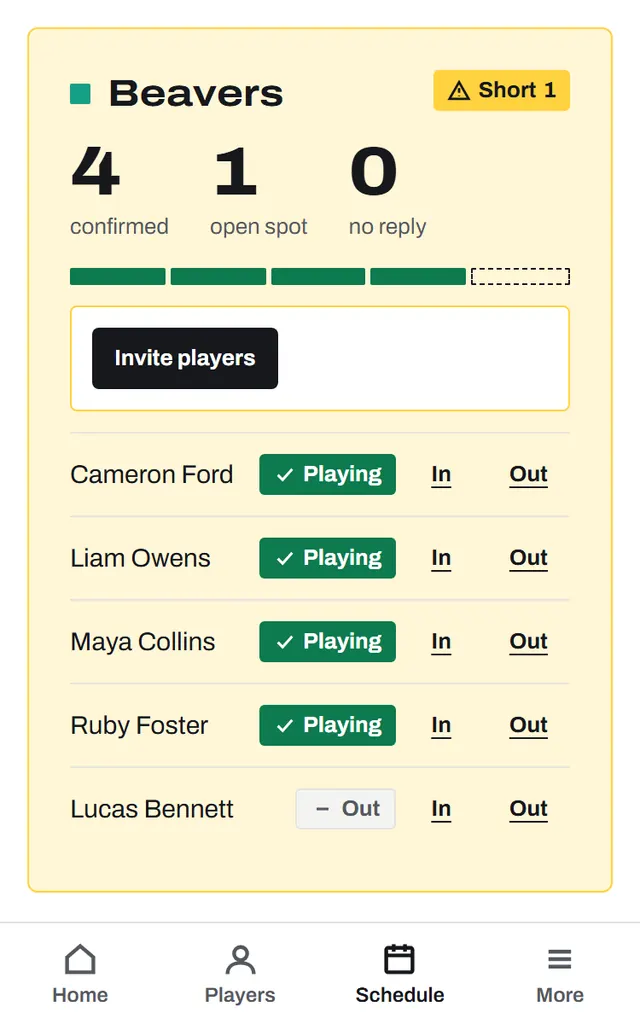
Notre Ligue has no reply deadline to set: answers stay open until the game starts, and it's up to you to tell your players when you want their answer. By default, the request goes out six days before the game, a reminder goes three days before to those who haven't answered, and the day before, the players who are in get the details with an "I can't play anymore" link.
When a player says they can't play and a spot opens, your subs are invited automatically, in waves of five every hour by default, or all at once within 48 hours of the game. The spot goes to whoever answers first. No sub is called in the last two hours before the game.
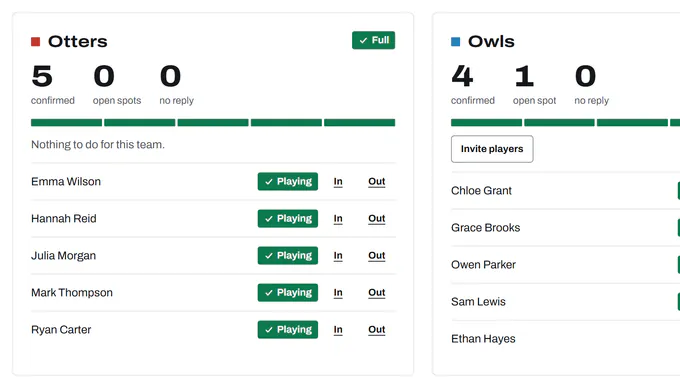
The game page shows who's playing, who's out and who hasn't answered, with a button to remind only those who haven't answered. If a player who had confirmed drops out within 24 hours of the game, you get an email. After the game, "Didn't show" marks a player who never turned up. See the plans
Frequently asked questions
Should a player who cancels the night before still pay?
That's for your league to decide, before the season. A regular usually pays for the season anyway; for a sub, the simplest rule is to pay only for games played.
How many subs should you call at once?
A few at a time when you have time, everyone at once on game day. The first to confirm gets the spot, and you thank the others.
What if two subs show up for one spot?
The first one who confirmed plays. The other gets a thank-you and priority next time, if your rule says so.
What if a team has to forfeit?
Apply the rule you wrote before the season, standings included. If the other team agrees, play a friendly game anyway with the players who showed up.