Make your pickup hockey teams with AI in two minutes
Published · Updated
Roberto Santana runs the SMBHL ball hockey league in Laval, Quebec.
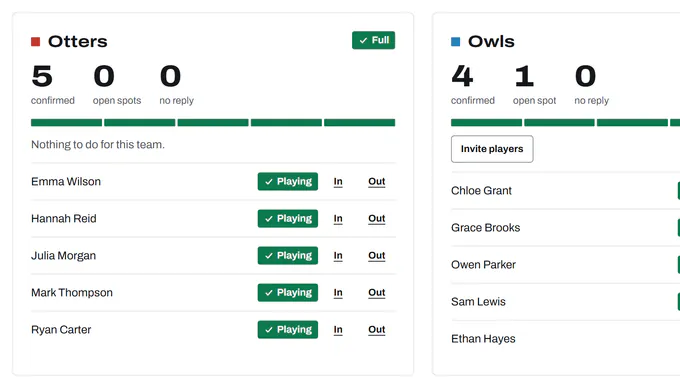
To build balanced teams for a pickup game, give each player a simple rating, paste the list into an AI assistant with a clear prompt, then check the totals before you announce the teams. Without AI, a snake draft with the same ratings gets very close. A league tool like Notre Ligue handles who's coming and the subs, and its draw can form the teams; the ratings you give the AI stay with you.
Ten minutes before the game, two captains pick players like it's fifth grade. The last ones picked pretend it doesn't bother them, and the game is decided before it starts.
Key takeaways
- A rating from 1 to 3 per player is enough; more nuance, more arguments.
- The prompt sets the rules: number of teams, one goalie per team, same number of players, close totals.
- AI can get a sum wrong or drop a name: always recount before you announce.
- Without AI, a snake draft with the same ratings does almost as well.
How do you rate your players simply?
Use three levels. 1: a beginner, or someone getting back into the game. 2: a solid regular. 3: one of the strongest in the group, the one who changes a game. Goalies don't get a player rating: mark them G, and they get split up from the start.
Do the ratings yourself, or with one other regular, and keep them to yourself. Nobody needs to know they're a "2". Adjust a rating after a few games if a player improves or comes back from an injury, not after one bad week.
New players start at 2. You correct it after their first game.
Which prompt should you use?
Copy this text into any AI assistant, then replace the list with this week's players:
Here are the players for this game, rated 1 (beginner) to 3 (very strong).
G = goalie.
Make 2 balanced teams, 1 goalie each, same number of players,
and rating totals as close as possible.
Each player must be on one team only.
Show each team with its players and its rating total.

Mark 3, Julie 2, Sam 1, Anna 2, Leo 3, Nadia 1, Paul 2, Chloe 2, Eric G, Tom G
First names are enough. If two players share a first name, add an initial, or replace names with numbers (Player 1, Player 2) and keep the key on your side. No last names, no emails, nothing personal.
What should you check before you trust the result?
An AI assistant answers fast and confidently, even when it's wrong. Take one minute:
- Count the players. Each team has the same number of players, or one more if the count is odd.
- Look for every name. Each player shows up once, not missing and not twice.
- One goalie per team. Never two goalies on the same team.
- Redo the sums. The totals shown are sometimes wrong; add them up yourself.
- Look at the gap. One point or less is balanced. More than that, ask for another split.
If something is off, just say what's wrong, for example "Sam is on both teams, start over". In my league, some seasons I've built the teams with AI, from the season's stats.
Which method should you choose?
| Method | Pros | Cons |
|---|---|---|
| Captains pick | Fast, everyone knows it | The last ones picked feel it, and teams are often uneven |
| Random draw | Neutral, nothing to prepare | The strongest players can end up together |
| Snake draft with ratings | No tool, balanced | You need ratings and a few minutes |
| AI assistant with ratings | Fast, shows the totals | You have to check the result |
Should you redo the teams every week?
In pickup, yes: attendance changes from week to week. Keep the ratings in one spreadsheet, next to the season schedule. Each week, take the players who confirmed, update the list and run the prompt again.
Before you run the prompt
- The list of confirmed players, goalies included.
- A rating from 1 to 3 for each, up to date.
- Goalies marked G.
- First names or numbers only.
- The number of teams you want.
- One minute set aside to check the teams.
Doing it by hand
A snake draft does the same job without AI. Put the goalies first, one per team. Then sort the other players from the highest rating to the lowest, and hand them out in that order: team A, team B, team B, team A, team A, team B, and so on.
With the prompt's list, that gives Mark, Leo, Julie, Anna, Paul, Chloe, Sam and Nadia, in that order. Team A gets Mark, Anna, Paul and Nadia: 3 + 2 + 2 + 1 = 8. Team B gets Leo, Julie, Chloe and Sam: 3 + 2 + 2 + 1 = 8. Eric and Tom go in net, one on each side. A perfect tie, in two minutes with a pencil.
With Notre Ligue
In a league set to "Teams formed every game", Notre Ligue's draw places the players who confirmed at random, spreading the goalies across the teams first, when you start it or automatically before the game if you turn on the automatic draw. If you turn on "Balance teams in the draw" in Settings, it uses each player's points per game when enough games have been played. For teams built from 1-to-5 levels that you give yourself, use the free team generator, no account needed. You can also assign each player yourself on the game page: enter the AI's teams there, and the draw will only place players who don't have a team yet.
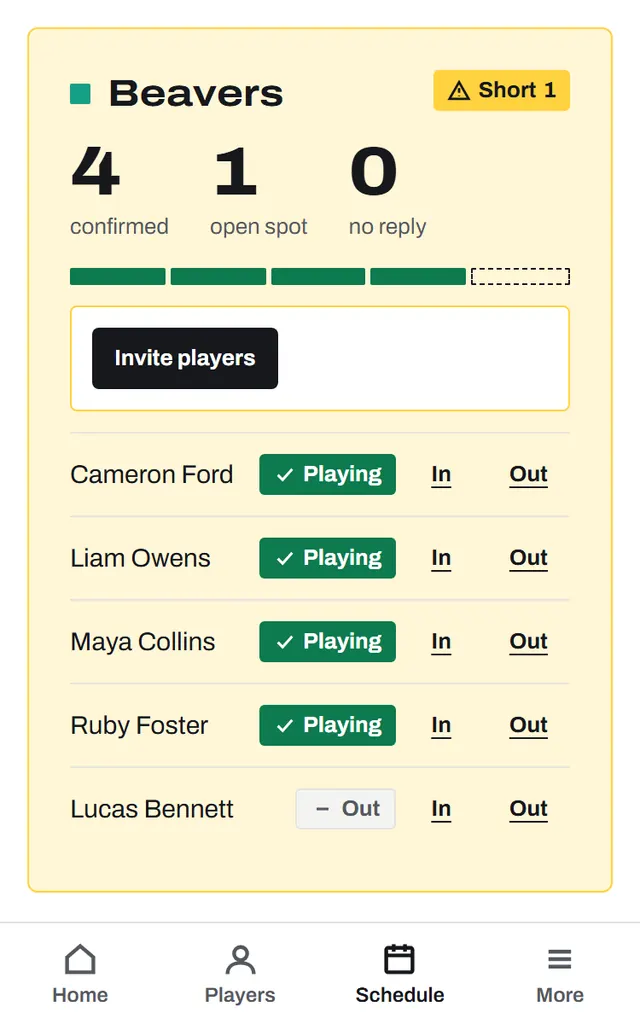
Notre Ligue also handles pickup leagues: who's coming, who's filling in. Create my league
Frequently asked questions
Which AI assistant should you use?
Any AI chat tool works: the prompt is plain text. The result can change from one tool to another, so always check it.
Should you tell players their rating?
No. Ratings are there to balance teams, not to rank people. Keep them to yourself, or between two organizers.
What if you have an odd number of players?
One team gets one more player. Give it to the team with the lowest rating total, or ask for that in the prompt.
Can I put full names in the prompt?
No need. First names or numbers are enough. Avoid last names, emails and any personal information in an online tool.