How to make a tournament bracket (free, no account)
Published · Updated
Roberto Santana, organizer of the SMBHL, a ball hockey league in Laval.
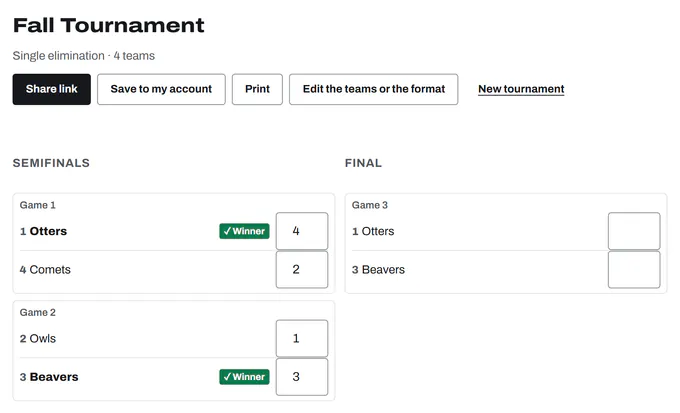
To make a tournament bracket, pick the format first, then place the teams (seeds and byes), then fill in the scores as games end. A free tool like Notre Ligue's bracket maker places the teams and moves the winners on for you, with no account. A printed sheet and a pencil work too.
The night before a tournament, the organizer always wonders who plays whom.
Key takeaways
- The format depends on the number of teams, the time you booked and the games you promised.
- With a number of teams other than 2, 4, 8, 16 or 32, the top seeds go straight to round 2.
- In a round robin, settle the points and the tie-breaks ahead of time.
- On tournament day, one person enters the scores.
Which format should your tournament use?
- Single elimination. One loss and a team is out. The shortest, but half the teams play only one game.
- Double elimination. A team is out after two losses. The losing teams carry on in a losers bracket, whose winner meets the winner of the winners bracket in a grand final.
- Round robin. Each team plays every other team once, and the standings decide the winner. The fairest, but the longest.
| Format | Best for | Minimum games per team | Total games, 8 teams |
|---|---|---|---|
| Single elimination | Little time, many teams | 1 | 7 |
| Double elimination | A full day, a second chance | 2 | 14 or 15 |
| Round robin | Few teams, guaranteed games | The number of teams minus 1 (7) | 28 |
The math: in single elimination, every game knocks out one team, so 8 minus 1. In double elimination, each of the other 7 teams needs two losses, so 14, plus a deciding game if the losers bracket team wins the grand final. In a round robin, 8 times 7, divided by 2, since every game counts for two teams.
How do you place the teams and the byes?
A seed is a team's rank before the tournament, by the season standings or your own judgment. Placed well, the two best can only meet in the final.
An elimination bracket comes out even with 2, 4, 8, 16 or 32 teams. Otherwise, you use the next size up, and the extra spots become byes: a team with no opponent goes straight to round 2. The byes go to the top seeds.
An example in single elimination, with 6 made-up teams: Wolves (1), Beavers (2), Eagles (3), Bears (4), Foxes (5) and Owls (6). The next size up is 8: 2 byes, for seeds 1 and 2.
- First round: Bears against Foxes, Eagles against Owls.
- Semifinals: Wolves against the winner of Bears-Foxes, Beavers against the winner of Eagles-Owls.
- Final: the two winners.
That makes 5 games in all.
How do round robin standings work?
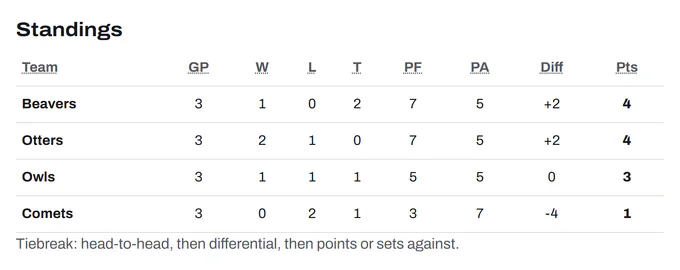
A common scale: 2 points for a win, 1 for a tie, 0 for a loss. That is the scale Notre Ligue's bracket maker suggests, and you can change it. When teams have the same points, the tool breaks the tie in this order by default:
- head-to-head
- the best differential (goals for minus goals against)
- the fewest goals against
- the team name, in alphabetical order
Its "Tiebreak" menu also offers the volleyball order (the set ratio, then the point ratio) and the softball and baseball order (the run differential first).
How do you make your bracket with the free tool?
- Open the free bracket maker and enter your teams, one per line, from 2 to 32.
- Pick the format.
- Pick the seeding: the order of your list, random or by hand.
- For a round robin, adjust the points and, for a schedule, your surfaces, the game length and the first game time.
- Tap "Create the bracket". The byes are placed and explained in one line.
- Tap "Share link" to send it to the teams, or "Print".
How does tournament day go?
One person enters the scores, on one device: the bracket is kept in that device's browser. At the end of each game, enter the score, and the winner moves on by itself. In elimination there has to be a winner: enter the final score, tiebreaker included.
Print a copy for the gym wall and keep it up to date in pencil. The shared link, on the other hand, shows the bracket as it was when you shared it: after new scores, share a new link.
Once the page has loaded, the tool no longer needs our server: if the Wi-Fi drops, keep the page open.
Before tournament day
- The teams, confirmed.
- The format, based on your time.
- The seeds and the byes.
- For a round robin, the points and the tie-breaks, in writing.
- The rule for a tie in elimination.
- The schedule and the surfaces.
- The person who enters the scores.
- A printed copy for the wall.
Doing it by hand
Take a large sheet and a pencil. Write the first round games in this order: for 8 spots, 1 against 8, 4 against 5, 2 against 7, 3 against 6. The two numbers of a game always add up to the size plus 1. A number higher than your number of teams is an empty spot: its opponent has a bye. With 6 teams, spots 7 and 8 are empty, so seeds 1 and 2 go straight to round 2. Put the sheet on the wall and write each winner into the next round.
For round robin standings, a spreadsheet is enough.
With Notre Ligue
Notre Ligue's bracket maker is free and needs no account, for 2 to 32 teams. It prints in black and white, on Letter paper in landscape.
"Share link" puts the whole tournament in the address, after the #. The browser does not send that part of the address when it opens the page, so the tournament never reaches our server. But anyone with the link can see the bracket, read only. "Make a copy to edit" gives them their own copy, without touching yours.
For a full season, the free schedule generator builds the season and the playoffs from your teams and your first date. For the method, read how to build your season schedule, and for the rest, how to organize a ball hockey league, step by step.
And if your rec league plays all season, Notre Ligue handles attendance and invites your subs when a player can't make it.
Frequently asked questions
How many games does an 8-team tournament need?
7 in single elimination, 14 or 15 in double elimination, and 28 in a round robin.
What if the number of teams doesn't come out even?
In elimination, the top seeds go straight to round 2: seeds 1 and 2 with 6 teams, 1 to 3 with 5. In a round robin with an odd number of teams, one team sits out each round.
Can the teams see the bracket without an account?
Yes. Anyone with the link sees the bracket read only, with no account. After new scores, share a new link.
Is the bracket maker really free?
Yes. No account, no email address to give.